
Pick crew socks if you want visible styling or extra protection: they're built for trail runs, deadlifts, and cuffed-jean fits where the sock is part of the look. Pick ankle socks if you want a low-profile finish or maximum breathability: they're the better call for road running, low sneakers, and hot-weather comfort. Both heights are made because neither wins every situation.
TL;DR:
- Choose crew socks for trail, lifting, or styled outfits where visibility and protection are priorities, as they cover more of the lower leg.
- Select ankle socks for running, gym cardio, or hot-weather conditions to maximize breathability and reduce bulk inside low-profile shoes.
- Prioritize proper fit, elastic cuffs, and moisture-wicking fabrics over sock height alone to prevent blisters and ensure comfort.
- Match sock height to activity risk: crew for debris and abrasion, ankle for heat and sweat management, and Cuff down crew if unsure for versatility.
- Both heights are designed deliberately to serve specific outfits and activities, reflecting different style and functional needs without compromise.
Table of Contents
- Crew Socks vs Ankle Socks at a Glance
- What Counts as an Ankle Sock vs a Crew Sock?
- Which Sock Height Fits Which Activity?
- How Sock Height Changes Your Outfit
- Materials, Fit, and Care That Actually Matter
- Why VALID Designs Both Heights Instead of Picking One
- Shop the Right Height for How You Actually Move
- Sources
Crew Socks vs Ankle Socks at a Glance
Before you dig into the reasoning, here's the short version you can reference while you're shopping or getting dressed.
- Best for: Crew wins for trail, hiking, lifting, and any outfit where you want the sock seen. Ankle wins for road running, gym cardio, and sneaker looks that hide the sock entirely.
- Warmth and breathability: Crew traps more heat and works better in cold weather. Ankle socks let more air circulate, which keeps feet cooler and helps manage sweat during summer training.
- Protection: Crew covers more of the lower leg, guarding against shin scrapes, trail debris, and shoe rubbing above the ankle. Ankle socks leave more skin exposed but reduce bulk.
- Footwear pairing: Crew pairs naturally with boots, high-tops, and mid-cut trainers. Ankle socks disappear inside low sneakers and dress shoes.
- Style vibe: Crew reads as intentional streetwear, often shown off above the shoe line. Ankle keeps the focus on the sneaker itself with a cleaner, minimal silhouette.
For fit and blister prevention, prioritize a snug (not tight) cuff and a heel that sits flush against your own heel with no bunching. A sock that slides inside your shoe causes more friction than one that's simply the "wrong" height. Read on for the specifics behind each of these calls, because the right choice shifts depending on the activity and the outfit you're building around it.
What Counts as an Ankle Sock vs a Crew Sock?
An ankle sock stops right around or just above the ankle bone, sitting at or slightly below where your pant hem naturally falls. A crew sock runs up to mid-calf, landing several inches above the ankle bone and often reaching where a cuffed jean or cropped pant would end.
Between those two sit a few variants worth knowing. No-show socks drop below the ankle bone entirely and hide inside the shoe, popular with loafers and boat shoes. Quarter socks (sometimes called low-crew) split the difference, covering the ankle bone but stopping well short of mid-calf. Over-the-calf (OTC) socks go past crew height, often used for dress socks or compression wear where you never want skin showing when you sit down.
Height changes how a sock interacts with your shoes and your pants. A crew sock under slim-fit ankle pants will show, whether you want it to or not. That same crew sock tucked into a boot disappears completely, doing its job as insulation and padding without ever being seen. An ankle sock under wide-leg trousers vanishes on its own. The same sock under shorts becomes the entire visual statement your shoe game is missing.
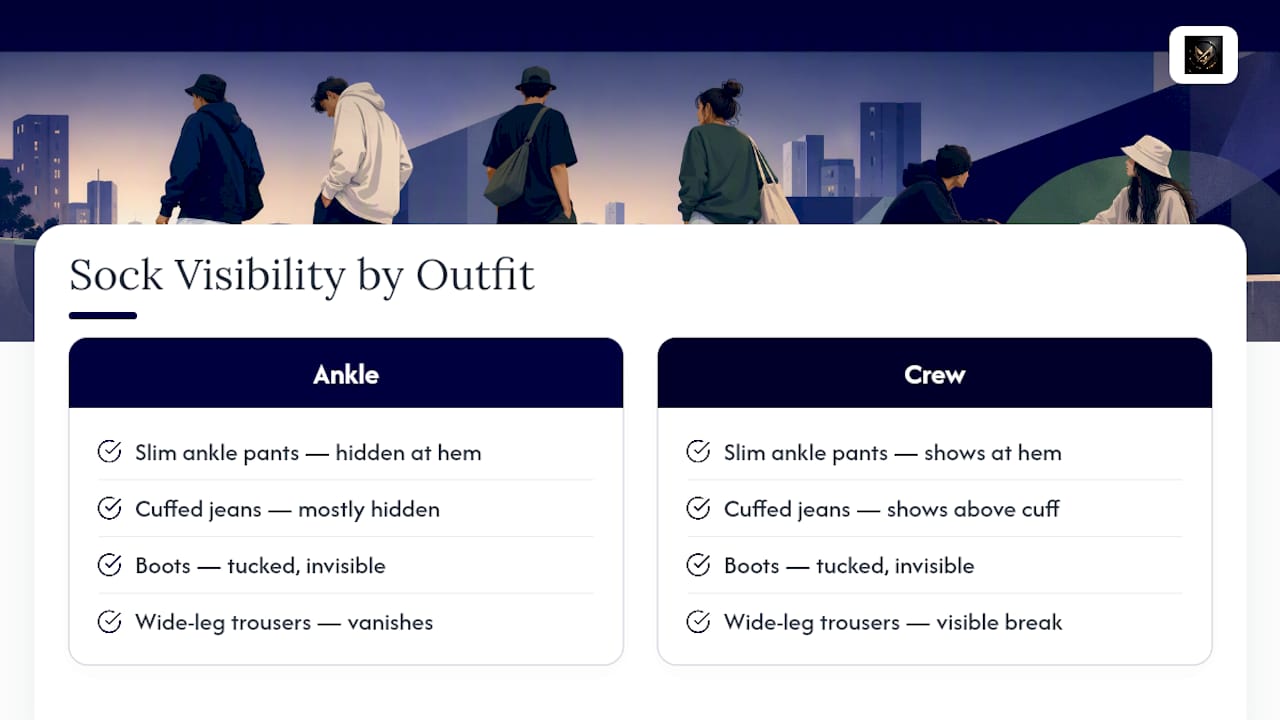
Leg proportion matters too. A crew sock in a contrasting color visually breaks up the leg line, which some readers like for adding texture to an outfit and others avoid because it shortens the look of the leg. An ankle sock keeps the leg line unbroken from shoe to hem, which tends to read as longer and cleaner. Neither effect is objectively better. It depends on whether you're building an outfit around visual breaks or visual continuity.
Which Sock Height Fits Which Activity?
Sock choice by activity comes down to one trade-off: protection versus breathability. Here's how that plays out across the activities readers ask about most.
- Trail running and hiking: Go crew. Trail runners switch to crew height specifically to keep pebbles, sand, and trail debris from working their way into the shoe, and the added coverage guards against branch scrapes and rock contact on technical terrain.
- Road running: Go ankle or no-show. On pavement there's no debris risk, so the priority flips to keeping feet cool and cutting bulk inside a low running shoe.
- Lifting and deadlifts: Go crew. Strength athletes wear crew socks during barbell work specifically to protect their shins from bar contact and abrasion during pulls, not for style.
- HIIT and track sprints: Go ankle. Fast, repetitive foot strikes generate heat quickly, and a shorter sock cuts weight and lets the ankle move freely.
- Everyday wear: Either, depending on the shoe. Boots and high-tops call for crew. Low sneakers and loafers call for ankle or no-show.
Trainers and stylists both point to the same rule here: match the sock to the risk, not the trend. When there's a real chance of friction, debris, or abrasion, function should override whatever look you had planned. Padding matters more in crew socks built for trail or lifting, since that's where shin and heel cushioning gets tested hardest. Moisture-wicking fiber content matters more in ankle socks made for running, since heat and sweat build up fastest in low-cut, high-intensity situations. Stay-up cuffs matter in both, but especially in crew socks, where a sock that slips down mid-run defeats the entire purpose of wearing it.
Pro Tip: If you're not sure which activity a sock will see most, buy crew. You can always cuff it down for a lower look, but you can't add height to an ankle sock once it's already too short for the trail.
How Sock Height Changes Your Outfit
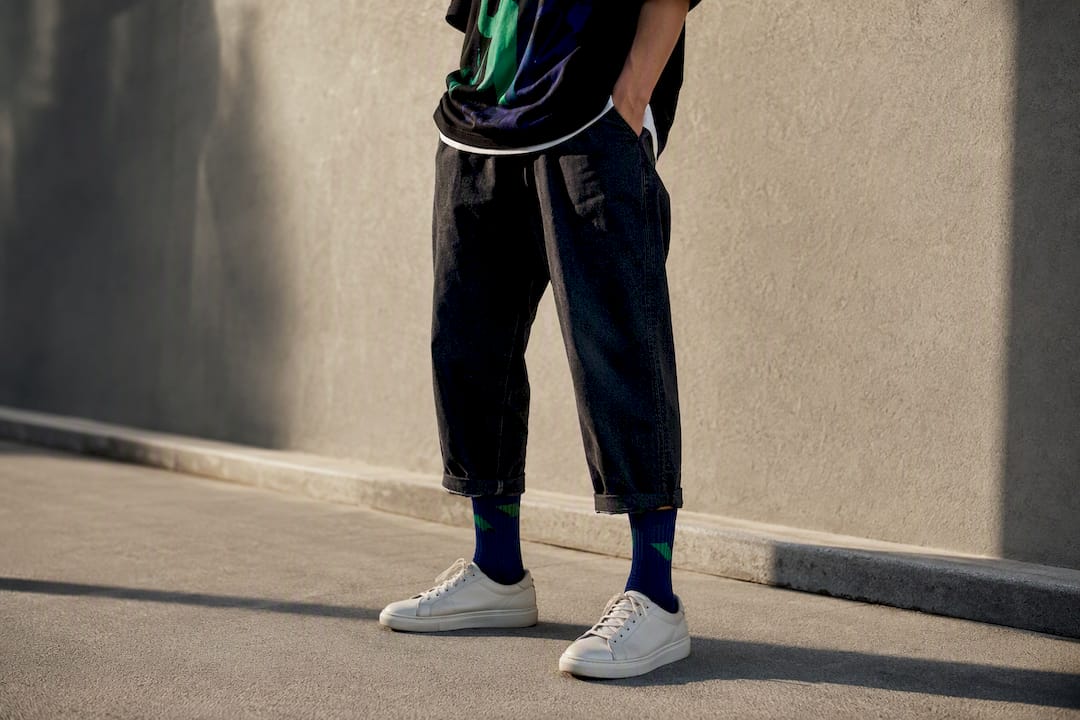
Sock height is one of the easiest ways to change the entire feel of an outfit without touching anything else you're wearing. A crew sock peeking out from cuffed jeans or cropped pants adds a visible layer of texture and color. An ankle sock under those same pants disappears, keeping the eye on the shoe and nothing else.
The generational split on this is fairly well documented. Gen Z shoppers tend to favor visible crew socks as an intentional accessory, often choosing bold colors or patterns that peek out on purpose above low-top sneakers. Millennials have leaned harder toward the minimalist ankle sock look, keeping the sock hidden and letting the shoe carry the outfit alone. Neither approach is more correct. They're two different visual languages, and plenty of people mix both depending on the shoe.
A few practical rules make the visible-sock approach easier to pull off:
- Contrast over match when you want the sock to read as a deliberate accessory, not an afterthought.
- Ribbed texture adds visual interest to a crew sock that's otherwise a solid color, especially under shorts.
- Logo placement matters on a visible sock. A small logo near the cuff reads intentional; a large logo across the shin can look accidental.
- Cropped pants and shorts are where crew socks do the most visual work, since more of the sock stays exposed.
- Cuffed jeans over boots favor crew in a neutral tone if you want the boots, not the socks, as the focal point.
Some of this is genuinely trend-driven rather than functional. Social media has amplified the visible-sock look into its own micro-trend, cycling through colors and patterns the way sneaker culture cycles through colorways. That's fine. Socks are one of the cheapest ways to update a look without buying new shoes.
If you're building a full outfit around a piece like a graphic hoodie or fleece pullover, socks are worth coordinating too. A graphic hoodie with a bold print pairs naturally with a crew sock in a matching or contrasting solid, since both pieces are already doing visual work in the outfit.
Materials, Fit, and Care That Actually Matter
Material choice affects comfort more than most people expect, and it matters roughly as much as height does. Cotton feels soft but holds moisture, which makes it a poor choice for anything sweaty. Wool, especially merino, regulates temperature in both directions and resists odor, making it the better pick for hiking or cold-weather wear. Synthetic blends like nylon and polyester with spandex wick moisture fastest and hold their shape longest, which is why most performance socks lean synthetic-heavy rather than pure cotton.
Fit matters just as much as fabric. Check that the cuff has enough elastic recoil to stay put without cutting off circulation, that the heel pocket lines up with your actual heel rather than sitting an inch off, and that any reinforced zones (usually the heel and toe) sit exactly where your foot takes the most impact. A sock that shifts inside your shoe creates friction no matter how expensive the fabric is.
Blister prevention comes down to fit and moisture control more than sock height. Peer-reviewed foot health research on blister prevention identifies friction and moisture as the two primary drivers of hot spots and blisters, which means the fabric touching your skin and how snugly it sits matter more than whether the sock ends at your ankle or your calf.
Care habits protect the investment. Wash in cold or warm water rather than hot, since heat is what breaks down elastic fibers and causes shrinkage over time. Skip the dryer's high heat setting for the same reason, and turn socks inside out before washing to protect any ribbing or logo detail on the outside.
- Cotton: soft, breathable in mild conditions, weak in sweat or wet weather.
- Wool blends: best temperature regulation, naturally odor-resistant.
- Synthetic blends: fastest drying, most durable under repeated washing.
- Cold-water wash, low-heat dry: preserves elasticity and prevents shrinkage.
Why VALID Designs Both Heights Instead of Picking One
There is an idea that self-expression shouldn't require a trade-off, and socks are a small but real example of that. Founder Ajakaye Okikiola Samuel approached the crew and ankle lineup the same way VALID approaches caps and apparel: figure out what the piece needs to do first, then decide what it should look like.
That means crew socks in the VALID lineup get built with cuff height and ribbing that hold up visually when worn above a low sneaker, since that's the whole point of choosing crew in the first place. Ankle styles get built lean, with attention to heel fit rather than added branding, because an ankle sock's job is to disappear into a shoe, not compete with it. Neither height is treated as the "default." Both get designed for the specific outfit and activity they're meant to serve.
— VALID
Shop the Right Height for How You Actually Move
If you've read this far, you already know your priority. Maybe you want the crew socks that show above a low sneaker with your cuffed jeans, or the ankle pair that vanishes under your trainers on leg day. Both types are available, built with fit and fabric details covered above, with cuffs that hold their shape, heel pockets that stay put, and materials chosen for the activity, not just the look.
When you're browsing, use the product filters to sort by height first, then check the fabric blend listed on each product page against what you'll actually be doing in them. Trail or lifting days call for the crew styles with reinforced zones. Running or everyday sneaker fits call for the ankle styles built for airflow. Either way, the goal is a sock that matches your outfit and holds up to what you put it through.
Start with the VALID home page to browse the current sock lineup and see which height fits what's already in your closet.