
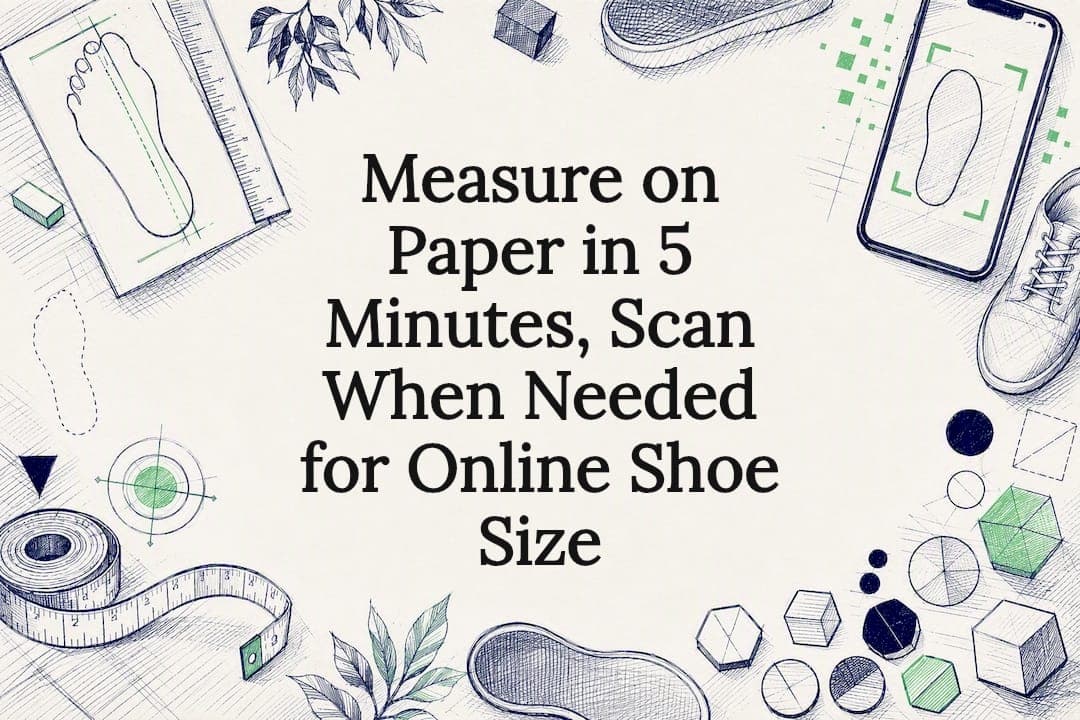
The fastest reliable method: measure both feet standing up, use the larger foot's length and width, add about 10 millimeters of toe room, then run that number through a brand-aware size calculator instead of a generic chart. If you land between two sizes on a closed shoe, size up. This five-minute process beats guessing from memory almost every time.
TL;DR:
- Measuring foot length should be done while standing in the afternoon with the toe added an extra 10 mm to account for toe wiggle room; always measure both feet and use the larger one.
- Shoe size conversions rely on centimeters plus a fitting allowance, with brand-specific fit offsets that significantly reduce mismatched orders.
- Width is as important as length, especially for wide or asymmetric feet; always size to the larger foot and consider wide options or half-size increases.
- Digital tools like phone scans are useful for high-cost or narrow shoes, but a simple paper measurement and a brand-aware calculator generally provide sufficient accuracy.
- When shoes arrive tight or loose, prioritize sizing up for closed shoes, check fitting points immediately, and use simple fixes like insoles or heel grips before returning.
Table of Contents
- How Do You Measure Foot Length and Width Accurately at Home?
- How Do You Convert Foot Measurements Into US, EU, or UK Sizes?
- Why Does Shoe Width Matter as Much as Length?
- Are Phone Scanning Apps and Web Sizing Tools Worth Using?
- What Should You Do If a Shoe Feels Wrong When It Arrives?
- What Guides VALID's Approach to Sizing?
- How VALID Helps You Get the Right Fit the First Time
- Sources
How Do You Measure Foot Length and Width Accurately at Home?
Skip the tape measure guesswork. All you need is a sheet of paper, a pen, a ruler, and a hard floor.
- Measure late in the day, standing, wearing the socks you'd actually wear with the shoe. Feet swell throughout the day, so a morning measurement can run small.
- Tape the paper to a hard floor (not carpet, which compresses and skews your reading) with one edge flush against a wall.
- Stand on the paper with your heel touching the wall and your weight evenly distributed, the way you'd stand while actually wearing shoes.
- Mark the tip of your longest toe with the pen held straight down, not at an angle.
- Measure heel to mark in millimeters or centimeters, using a ruler or tape measure.
- Measure width at the ball of your foot, the widest point, while still standing.
- Repeat for both feet. Most people have a size difference between their left and right, and you always fit to the bigger one.
Do the whole process twice per foot to catch measuring errors, and jot down any asymmetry so you remember it next time. The two most common mistakes are measuring while seated (your foot flattens less than it does under full body weight) and measuring on carpet, which throws off the wall alignment. At-home paper-and-ruler measuring works well for online orders as long as you're standing and consistent.
Pro Tip: Snap a photo of your marked paper before you toss it. You'll want that reference the next time you check sizing on a different brand's site, and most sizing calculators ask for the exact number in centimeters.
How Do You Convert Foot Measurements Into US, EU, or UK Sizes?
Your foot length in centimeters is the anchor number. Everything else, US, EU, UK labels, is a translation layered on top, and translations don't always agree between brands.
A standard conversion works roughly like this: take your measurement in centimeters (multiply inches by 2.54 to convert), add a fitting allowance, then translate that padded number into a base size. Most shoe size calculators follow this exact sequence, converting cm to a base EU size before mapping it to US and UK equivalents.
- The fitting allowance is usually about 10 millimeters added to your raw measurement. That extra space accounts for toe wiggle room and the way your foot lengthens slightly under load-bearing weight when you walk.
- Brand fit offsets come next. A calculator that only converts centimeters to a generic size chart ignores the fact that one brand's size 9 runs long while another's runs snug. Tools that apply brand-specific fit offsets nudge the recommendation up or down based on how that specific brand's lasts tend to run.
- That brand-aware step is also what separates a useful calculator from a basic conversion table, since mapping foot length to a brand's own thresholds cuts down on mismatched orders far more than a one-size-fits-all chart does.
Here's the math in action: a foot length around 27 centimeters, once you add the fitting allowance, typically lands around a US men's size 10 on a standard last. But feed that same 27.0 cm into a brand known for running small, and the calculator might bump you up half a size. Treat your centimeter measurement as the fact and the size label as the brand's best guess.
Why Does Shoe Width Matter as Much as Length?
Length gets all the attention, but width is often the reason a "correct size" shoe still feels wrong. Width letters, B, D, E, EE, and so on, aren't arbitrary. Each step represents a small width increment (about a quarter inch or six millimeters) at the ball of the foot, and width scales proportionally with length, meaning a size 10 wide and a size 9 wide aren't the same actual width.
- If your length and width measurements point to different conclusions (say, your length says one size but your foot is noticeably wide for that size), look for a wide-width version of the model first.
- No wide option available? Sizing up half a size in the standard width often solves the width problem, though you may need an insole to manage extra length.
- Kids' feet grow fast. Leave about a thumb's width of space beyond the longest toe when fitting children's shoes, and re-measure regularly rather than assuming last season's size still fits.
- Asymmetric feet are common, not a defect. Always size to the larger foot, and use a thin insert or heel grip in the smaller-footed shoe if there's a noticeable gap.
Are Phone Scanning Apps and Web Sizing Tools Worth Using?
They're worth using selectively, not for every single order.
- Start with the paper measurement. It costs nothing, takes five minutes, and gives you a reliable centimeter figure for any calculator on the internet.
- Use a web-based calculator that accepts your cm measurement directly. These tools apply the fitting allowance and brand offsets automatically, which is the real advantage over eyeballing a size chart yourself.
- Consider a phone scan for higher-cost purchases or narrow-fit models where a wrong guess is expensive to return. Some phone-scanning services use a single photo, others use multi-angle AR capture, and they generally trade a little setup friction (camera permissions, sometimes an email signup) for a more precise width and volume read than paper alone provides.
- Skip the scan for basics. A well-taken paper measurement fed into a brand-aware calculator is usually enough for sneakers, socks, and other forgiving fits. Save the scan step for shoes where sizing mistakes are costly.
Digital sizing tools that map centimeter measurements to brand-specific charts exist precisely because generic conversion tables miss brand-to-brand quirks, and that mapping is where most of the accuracy gain actually comes from.
What Should You Do If a Shoe Feels Wrong When It Arrives?
Some rules of thumb settle the close calls fast.
- Between two sizes on closed shoes (sneakers, boots, dress shoes)? Go with the larger size. Excess length is fixable with an insole; a too-small shoe usually isn't fixable at all.
- Between two sizes on sandals or slip-ons? The smaller size can work fine here since there's less structure squeezing your toes.
- On arrival, check three things immediately: room to wiggle your toes, whether your heel slips when you walk, and any tight spots across the top of your foot or at the width points.
- Quick fixes before you return anything: a thin insole tightens up excess length, heel grips stop slip, and a thicker sock can fill out a shoe that runs slightly big.
- When fixes won't cut it, use the return window rather than living with pain points. For borderline calls on models known to run inconsistently, ordering both sizes and returning one is often cheaper in time and hassle than a back-and-forth exchange.
Pro Tip: Test new shoes on carpet indoors for ten minutes before deciding. Pressure points that seem minor standing still often turn into real problems once you're walking around.
What Guides VALID's Approach to Sizing?
I started VALID on the idea that confidence shouldn't be undermined by a shoe that doesn't fit right. Ajakaye Okikiola Samuel here, founder of VALID: we built our sizing guidance around the same fit-first logic in this article because a mismatched size erodes the whole point of wearing something you feel good in. Clear size charts and responsive support aim to keep returns low and confidence high, with plans to build out more customer fit data as the brand grows.
— VALID
How VALID Helps You Get the Right Fit the First Time
The size chart is built around real measurements rather than a generic conversion table, helping make sizing easier to determine when ready to buy. Product pages include fit notes, and support is available for sizing guidance.
Take the centimeter measurement you just took, check it against the size chart on any VALID product page, and reach out to support if you're stuck between two sizes before you check out. Getting it right the first time beats waiting on an exchange.